

Fabric Data Warehouse: Bringing Structure to Modern Data Strategies
In the rush to embrace the latest data architecture trends, the lakehouse has dominated the conversation. While it offers flexibility, scalability, and native support for big data analytics, it’s not necessarily the best fit for every organisation, especially those with a strong background and investments in traditional data warehousing in terms of both solution architecture and technical capability.
For businesses that have built their data ecosystems around SQL Server, stored procedures, and highly relational datasets, the Microsoft Fabric Data Warehouse provides a compelling alternative. It delivers the power of modern cloud architecture while retaining the structure, performance, and familiarity of a traditional data warehouse. Now, with SQL Database in Microsoft Fabric generally available, organisations also have a native option for operational and transactional workloads alongside analytics.
If you’re coming from an enterprise SQL background, it’s worth asking: Why reinvent the wheel when you don’t have to?
What is the Lakehouse in Microsoft Fabric?
Before we dive into Fabric Data Warehouse, we need to understand what is the the lakehouse in Microsoft Fabric. The Lakehouse in Microsoft Fabric is a modern data architecture that blends the scalability and flexibility of datalakes with the performance and structure of traditional data warehouses. It stores data centrally in OneLake using open formats like Delta Parquet, supporting a wide range of analytics workloads, from data engineering and science to real-time dashboards, all without the need for data duplication.
While the Lakehouse model excels at handling semi-structured or unstructured data at scale, it often requires organisations to adopt new tools, processing frameworks, and governance practices. For teams grounded in SQL-based data management or with existing investments in traditional data warehouse infrastructure, this shift may introduce unnecessary complexity.
That’s where the Microsoft Fabric Data Warehouse stands out, offering a modernised approach that retains the familiarity and performance of a relational system while still integrating seamlessly with the wider Microsoft Fabric ecosystem.
A Familiar Yet Modern Data Warehouse
One of the biggest advantages of the Microsoft Fabric Data Warehouse is how it supports SQL-based workloads and offers continuity for SQL Server professionals. While lakehouse architectures often require a shift in thinking; adopting new languages, techniques and governance approaches, the Fabric Data Warehouse allows experienced teams to leverage existing skills.
Keep your stored procedures and T-SQL workflows: No need to rewrite complex business logic in Spark notebooks. Some minor changes might be required, but the Microsoft Migration Assistant will provide the necessary guidance.
Maintain a relational approach: If your data is inherently structured and relational, why force it into a lakehouse model that prioritises semi-structured and unstructured data?
Faster adoption with a flatter learning curve: Your team can hit the ground running, reducing the time and cost associated with retraining and re-engineering.
Built for Scale with Delta Parquet Underpinnings
Fabric Data Warehouse is more than a rebranded SQL Server in the cloud. It is built on high-performance, scalable architecture that leverages Delta Parquet storage under the hood. This brings significant benefits:
Best of both worlds: You get the performance and query optimisation of a structured data warehouse, with the scalability and efficiency of an open data format (Delta Parquet).
Optimised storage and compute: Data is stored efficiently, reducing storage costs while enabling fast query performance.
Columnar storage and ACID transactions: Ensures reliability, data integrity, and high-speed analytics processing.
Benefit from Microsoft Fabric without sacrificing the familiarity of the Warehouse
Just because you’re choosing a data warehouse doesn’t mean you’re missing out on the benefits of Microsoft Fabric. Microsoft Fabric implementation provides a unified analytics platform, and the Fabric Data Warehouse fully integrates with its ecosystem:
Lower compute costs: Fabric’s serverless and scalable architecture means you can optimise costs based on usage rather than paying for always-on compute.
Access to AI and data science tools: Seamlessly integrate with Fabric’s data science and machine learning capabilities without needing to shift to a lakehouse.
Purview for governance and security: Maintain enterprise-grade security, compliance, and data lineage tracking.
Phased migration supporting legacy dependencies
A complete shift to Fabric doesn’t have to happen overnight. Many organisations have a complex data landscape which has evolved over time with dependencies that must be taken into consideration. The Fabric data warehouse can support legacy processes, such as multidimensional cubes, reporting, and integrations, during the migration journey. This allows efforts to be focused on areas that will deliver the most immediate value. By adopting a phased approach, organisations can smooth the transition and begin realising the benefits of a unified modern data platform sooner, such as enhanced data governance through Azure Purview and opportunities for advanced analytics.
Accelerate the transition with a Metadata driven ELT framework
Using a metadata-driven ELT (Extract, Load, Transform) framework for efficient data migration and to ingest data for Microsoft Fabric is important because it provides flexibility, scalability, and automation in handling data pipelines. The Fabric SQL database is the perfect place to store related metadata all under one roof. This approach will accelerate a data migration ensuring that data transformations and loads are efficient, consistent, and easy to maintain as the system evolves. Additionally, it enhances data governance and traceability, allowing for better data lineage tracking and improved troubleshooting.
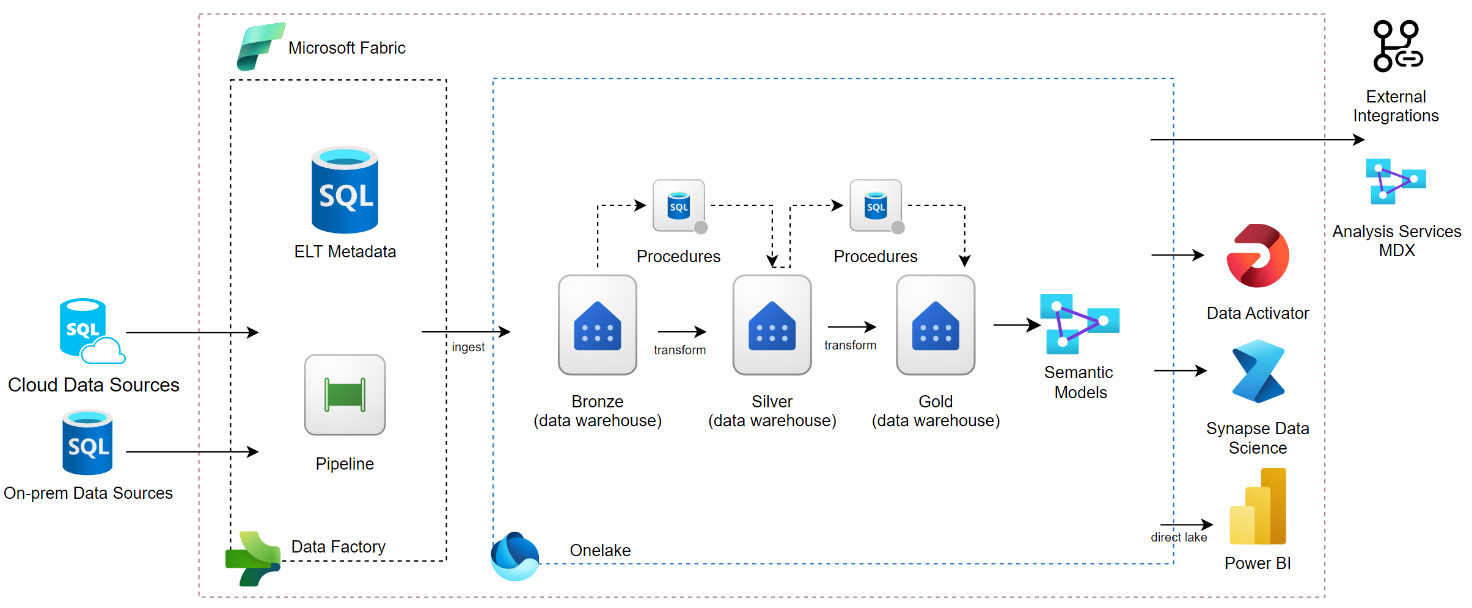
Choosing the right tool for the job in Microsoft Fabric
Microsoft Fabric now gives organisations more choice in how they run data workloads, including the Fabric Data Warehouse and the Fabric SQL Databases. For most analytics, reporting and BI scenarios, Fabric Data Warehouse should be the starting point. It is purpose-built for structured, relational analytics and delivers the performance, scalability and familiar SQL experience that enterprise data teams depend on. If you are migrating from SQL Server, Azure Synapse or a traditional warehouse estate, Fabric Data Warehouse provides the most natural and low-friction path forward.
Fabric SQL Database, now generally available, serves a different purpose. It is optimised for application and transactional workloads where low-latency inserts and updates are critical. This makes it ideal for operational systems, but it is not designed to replace a dedicated analytics warehouse.
In practice, many organisations will use both, SQL Database to power operational applications, and Fabric Data Warehouse to power analytics, reporting and insight. For governed analytics at scale, the Warehouse remains the right home.
Conclusion
The right data architecture isn’t about trends, it’s about what works for your organisation. While the lakehouse model suits unstructured data, businesses built on SQL Server and relational datasets may benefit more from Microsoft Fabric Data Warehouse.
With Fabric Data Warehouse, you can modernise without disrupting existing workflows, gaining cloud scalability while keeping familiar SQL-based processes.
How Simpson Associates can help
Being a Microsoft Fabric Featured Partner, we help organisations navigate their Fabric and data transformation journey. With the right guidance, you can leverage Microsoft Fabric effectively to achieve your goals and drive success.
Read more about Simpson Associates Fabric Accelerator and our Microsoft Fabric consulting services or reach out to us via live chat to get started on your Fabric journey today.
Blog Author: Stewart Duffill, Principal Consultant at Simpson Associates


- Share